
PRAYERHOUSECOFFEE
Business Plan and Ministry Charter
The Living Sanctuary Company
“My house will be called a house of prayer for all nations.” Isaiah 56:7
1.Executive Summary
America closes roughly four thousand churches a year, and the most beautiful buildings in a thousand towns are going to auction, to demolition, or to developers who strip the glass. Prayerhouse Coffee buys the best of them and gives every square foot a living: a specialty coffeehouse and open house of prayer in the nave, loft homes in the school and rectory wings, and weddings, worship nights, and concerts under the original stained glass.
The financial architecture is deliberately ordinary so the mission never has to be: the apartments are sized to carry the debt by themselves, the cafe carries the community and daily cash flow, the events carry the margin, and federal plus state historic tax credits return 30 to 50 percent of restoration costs on National Register buildings. The sanctuary itself is never gutted and never mortgaged to a use it cannot dignify.
The structure of this venture: the founder contributes the vision, the brand, the acquisition pipeline, all technology, and full project management. Investors provide complete funding for acquisition, restoration, and working capital through a dedicated entity per house. The first house is fully scouted, with a national registry of 36 verified candidate buildings and three ranked contenders, and requires approximately $3.4 million gross (about $2.3 million net of expected credits).
The thesis in one sentence: the homes carry the mortgage, the coffee carries the community, the events carry the margin, and the mission rides on rails a bank already understands.
2.The Conviction
The buildings are dying. Lifeway Research counts about 4,000 US Protestant church closures a year against 3,800 openings. The United Methodist wave shook 7,651 buildings loose between 2019 and 2023. Catholic dioceses from Buffalo to Detroit to Newark are consolidating hundreds of parishes. Today these sanctuaries become breweries, climbing gyms, and condos, or they rot. Someone will buy them. The question is who, and for what.
The third place is disappearing. The rooms where people gathered casually and repeatedly have thinned out of American life, and the loneliness that followed is documented by everyone from the Surgeon General to every barista who watches a regular linger because home is empty.
Coffee is the one liturgy everyone still keeps. All nations, all politics, all ages. A coffeehouse is the one room a skeptic enters gladly, daily, on their own initiative. It is the lowest doorstep the church has ever had, and it is for sale.
3.The Living Sanctuary Model
Every house runs three engines under one roof, each in the part of the campus built for it:
- The Nave: coffee, prayer, and music. A serious specialty coffeehouse at the narthex end, an open prayer chapel at the altar end, and the room's true calling (voices and music under glass) restored on evenings and weekends. The nave is never gutted; furniture, bar, and stage are freestanding and reversible.
- The Wings: homes. Loft apartments in the school, rectory, and convent buildings, whose ordinary floor plates convert at ordinary cost. Their rent is sized to cover 100 percent of debt service alone.
- The Calendar: celebrations. Weddings, concerts, retreats, and community events in the most beautiful room in town, at premium margins that fund the ministry and the upside.
The model exists because of one number: converting a sanctuary into ordinary commercial space runs toward $1,000 per square foot, while fitting out ordinary rooms runs a fraction of that. We refuse the expensive mistake on principle and on math: the sanctuary stays a sanctuary, and the money goes where conversion is cheap.
4.The Preservation Covenant
Written into every deal, printed on every wall, and aligned with the Secretary of the Interior's Standards that the historic tax credits already require:
- No bedroom in the nave. Ever. Homes live in the secondary buildings. The sanctuary remains one continuous sacred room.
- The glass, the organs, the bells, and the woodwork stay. Stained glass is restored and lit, never removed or sold. Working organs are maintained and played. Pews are refinished into seating in the room they have always served.
- Reversibility. Everything inserted is freestanding. If the mission ever ends, the building is still a church.
- The altar end is never merchandise. A dedicated prayer space remains open during all operating hours, including ticketed events.
5.The Name, the Verse, and the Glass
The brand rests on two verses: Isaiah 56:7, where God's house is called a house of prayer for all nations, and Psalm 141:2, where prayer rises like incense. Steam rising from a cup is the most honest picture of prayer a coffeehouse could ask for, and the mark is a chapel arch holding a cup, with the steam escaping through an open roof in the colors of stained glass.
The visual identity is called Light Through Glass: a white sanctuary, ink typography, and every drop of color arriving as light through the windows. Its signature is the Prayer Window: every prayer left with the house adds one pane to a living rose window that grows week by week, online first and one day in built glass. Requests stay private with the intercession team; the panes are anonymous. The people are the glass.
6.Market
Demand, three ways
- Coffee: the US coffee shop market generates tens of billions annually and has proven recession-resistant; the morning ritual is the last discretionary purchase households cut.
- Homes: every target market carries multi-year rental demand; character lofts in historic buildings rent at premiums and hold occupancy through cycles.
- Celebrations: couples already pay thousands for a room with half the beauty of an 1888 nave; unique-venue weddings and small concerts are among the highest-margin uses a historic room can host.
Supply, verified
Our national sweep (August 2026) confirmed 750+ religious properties listed on LoopNet and 1,607 on CREXi, with the richest concentrations in Upstate New York, Ohio, Pennsylvania, and Michigan. Intact small-town churches clear at $40,000 to $215,000; full parish campuses with rectories and schools run $350,000 to $750,000. Diocesan disposition pipelines in Buffalo and Chicago sell directly and never reach the open market. Comparable sales confirm the bands. Supply is not the constraint; discernment is.
The subsidy
National Register buildings carry a 20 percent federal historic tax credit on qualified rehabilitation expenditures, stackable with state programs (20 percent in New York) and, for civic-priority buildings, DRI and CDBG funding. The paperwork is demanding, which is precisely why it is a moat: brewery conversions rarely bother.
7.The Houses
Three ranked contenders from the 36-building registry, each verified to a live listing and each chosen because it has a glorious nave, ordinary secondary buildings, and a real rental market. Renderings below are concept visualizations of the model applied to buildings of this type.
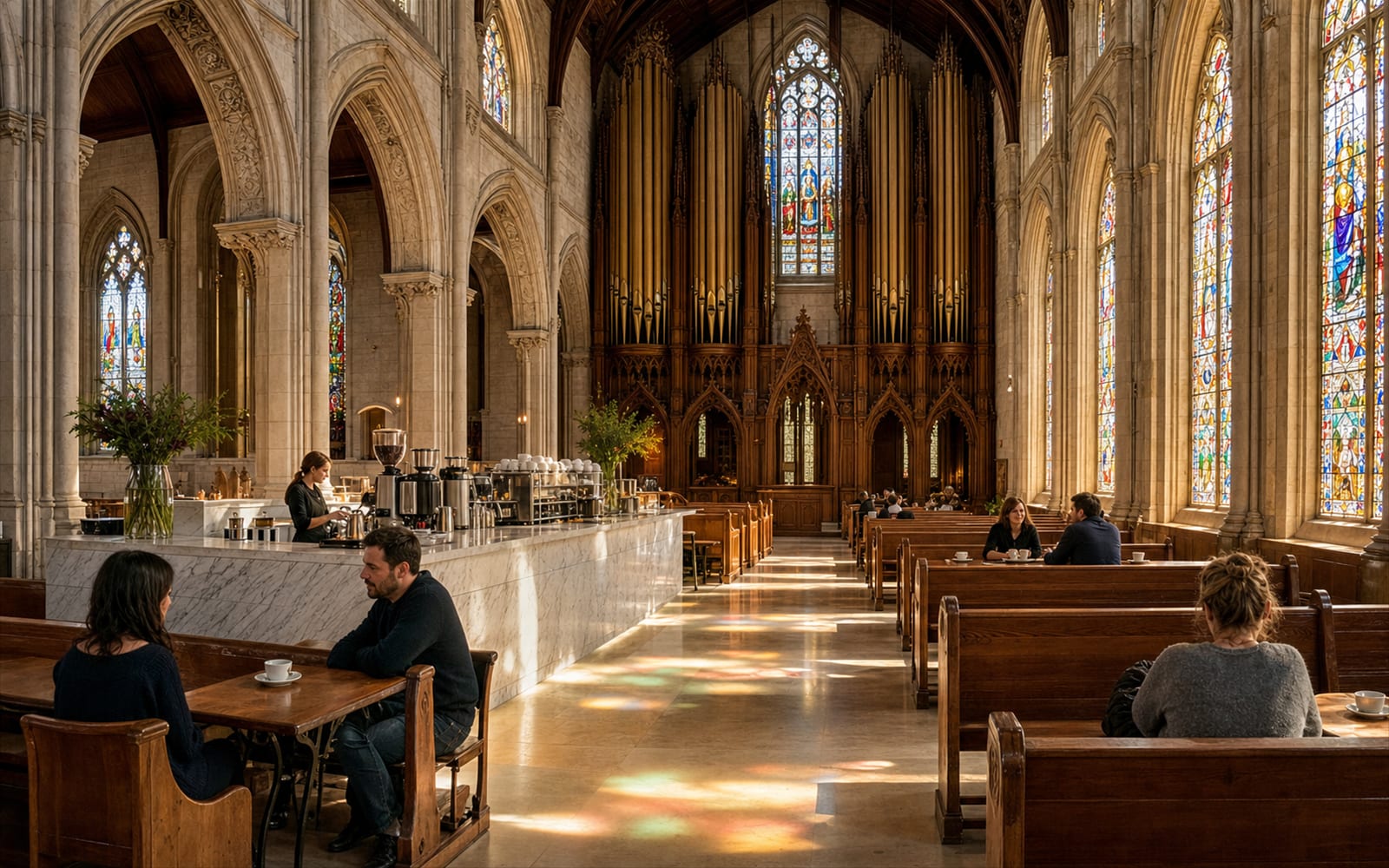
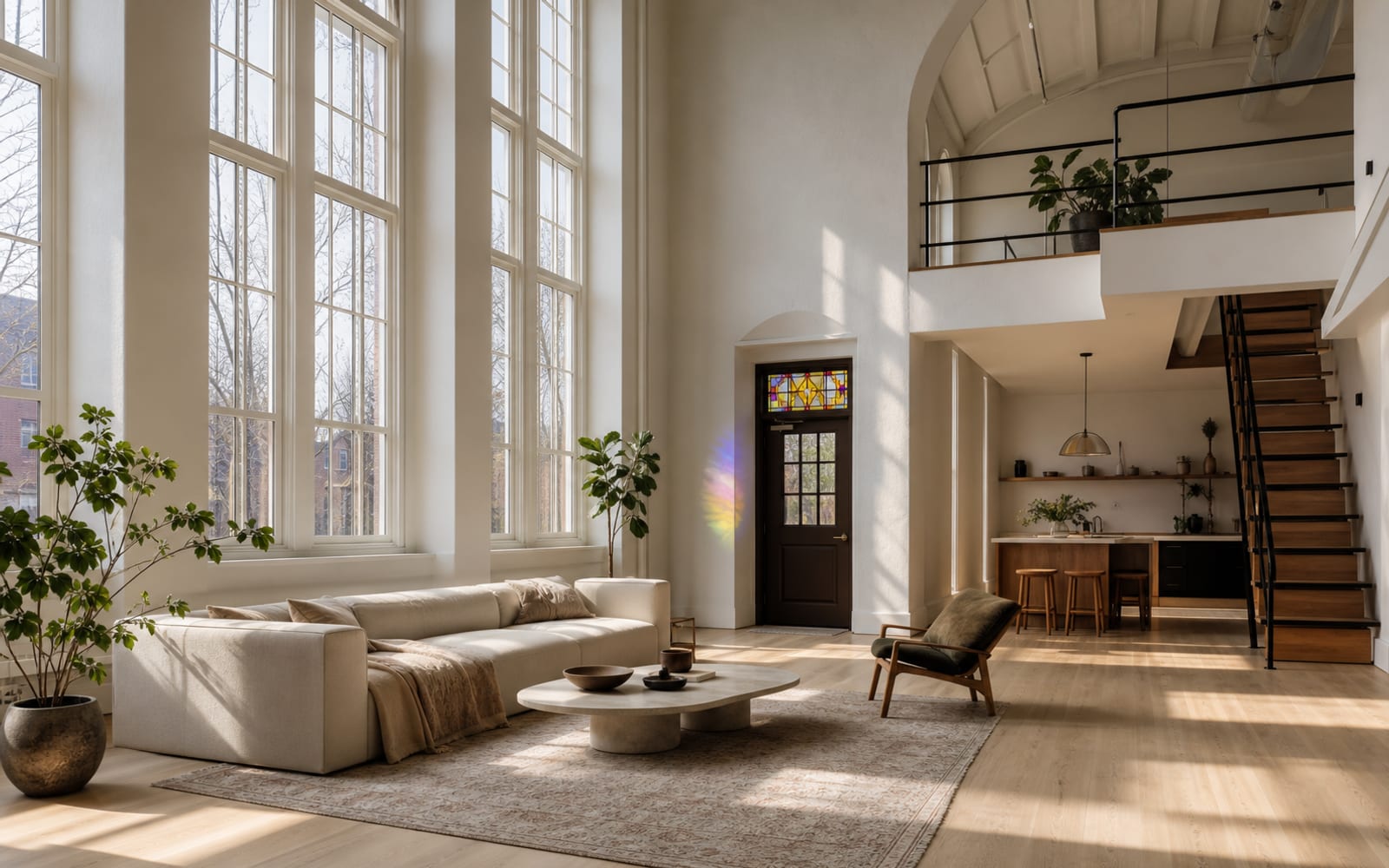
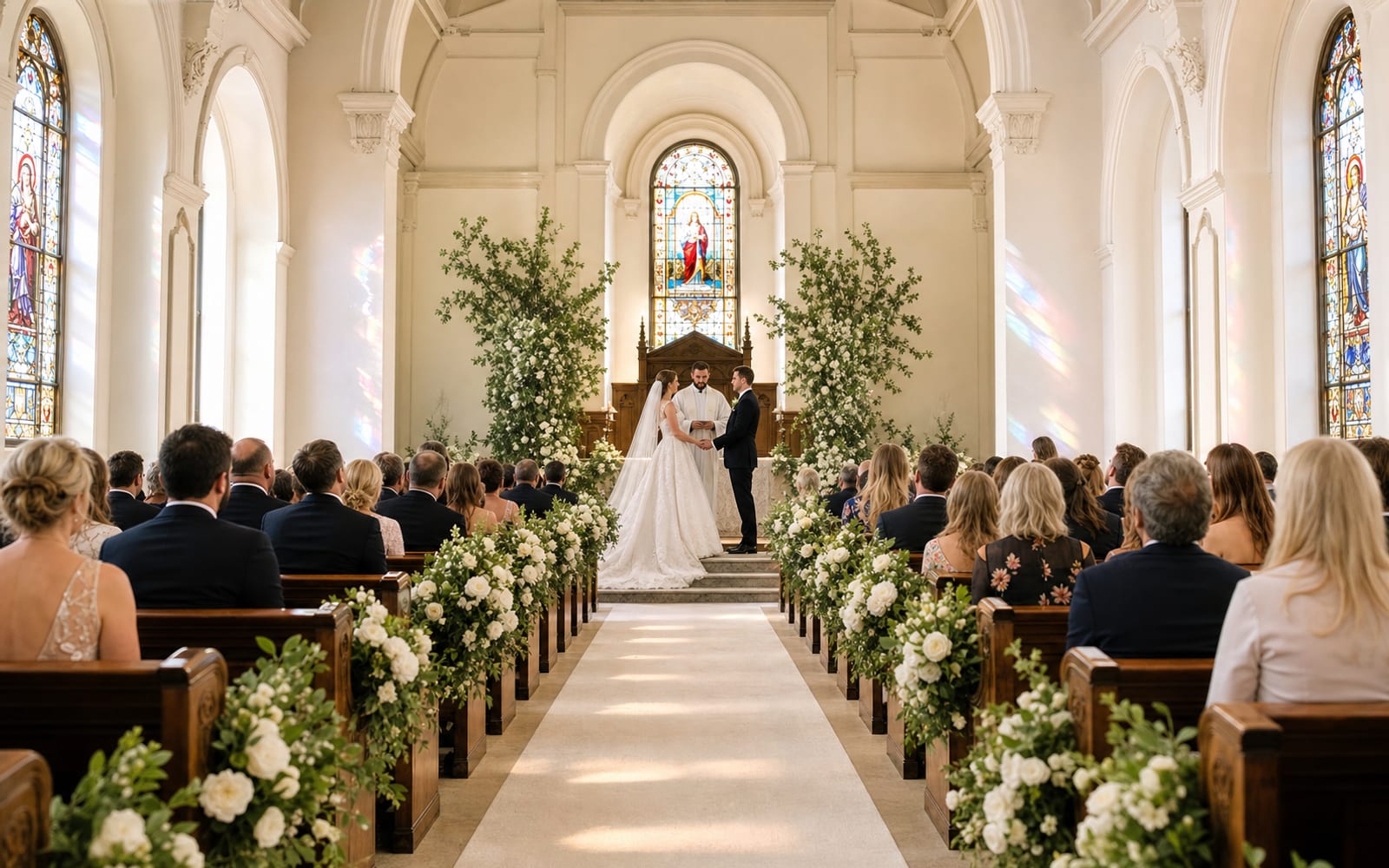
Concept visualizations, not construction documents. Every intervention shown is freestanding and reversible per the Covenant.
| House | Building | Entry | Why it leads |
|---|---|---|---|
| I · The Proof | St. Clare Church, Buffalo, NY (1888, National Register) | $500,000 | Four rectory apartments already renting (~$5,000/mo), city-approved event plans, working organ, full credit stack. Income from day one. |
| II · The Crown Jewel | St. Peter's Church, Rectory + Convent, Kingston, NY (1871) | $695,000 | Three parcels on the Rondout waterfront arts strip; Hudson Valley rents and the region's premier wedding room. |
| III · The Scale Play | Mulberry Presbyterian + School, Pittsburgh, PA (1911) | $349,900 | 55,000 SF; the school becomes 20+ lofts, the gym becomes the loud-night venue, the sanctuary keeps its dignity. |
| Wildcard | St. Joseph's Church, Albany, NY (1856, Patrick Keely) | $100,000 | A city-owned cathedral-grade flagship with DRI/CDBG support; held for the movement's Notre-Dame moment after Houses I and II prove the engine. |
8.How a House Pencils
| Layer | What happens | Shape of the money |
|---|---|---|
| Acquire | Full parish campus, church plus school or rectory | $200K – $700K |
| Restore + convert | Light-touch sanctuary; 8 to 24 lofts at ordinary conversion cost ($200 to $275/SF) | $2.5M – $6.5M |
| Credits + grants | Federal 20% + state credits + civic funding where cities want the save | 30% – 50% back |
| Homes | Rents sized to cover 100% of debt service alone | $170K – $340K/yr |
| Cafe | Standard specialty economics in an unforgettable room | $60K – $90K/yr net |
| Events | 40 to 70 weddings, concerts, and retreats a year | $80K – $200K/yr net |
| The point | Stabilized yield on net-of-credit basis, mission funded by margin | Target 8% – 11% |
The two-question gate every acquisition must pass: do projected apartment rents alone cover projected debt service, with cafe and events counted as zero? And would a stranger walking into the nave gasp? Both answers must be yes. The first protects the investors. The second protects the mission.
9.The Ministry Model
Everything spiritual in the house is a rhythm, not a program, so it costs almost nothing and cannot be killed by a hard quarter: fifteen minutes of morning prayer, a one-minute midday pause at the bell, Thursday worship nights, Saturday concerts, closed Sundays (we are at church, not running one). Staff are hired for craft and warmth, never asked to evangelize, and welcome from any faith or none. Local churches are partners, never competitors; guests who ask about faith are connected to congregations, not kept in-house.
10.Founder, Team, and Structure
Sarah Scarano, Founder. Multi-venture builder and AI systems architect (Modern Mustard Seed). To this venture she contributes the four things money cannot buy off a shelf:
- The vision and the brand: the Living Sanctuary model, the Preservation Covenant, the Light Through Glass identity, and the Prayer Window, already designed and live.
- The acquisition pipeline: the 36-building national registry, ranked contenders, diocesan relationships in formation, and a repeatable eight-step scouting discipline.
- All technology, in-house: web, booking, events, resident and donor systems built at Modern Mustard Seed at no agency cost, a structural advantage over every independent operator in this space.
- Full project management: founder-led delivery from offer through opening day, with the operating playbooks written before the doors open.
The funding structure sought: complete outside funding of each house through a dedicated per-house entity. Investors capitalize acquisition, restoration, and working capital; the founder serves as sponsor and manager, with founder and investor economics finalized with counsel at term-sheet stage. Key hires per house: a general manager with a pastor's heart and an operator's spine, a preservation architect, a historic-credit consultant, and an adaptive-reuse general contractor.
11.The Ask
| Use | Amount |
|---|---|
| Acquisition (St. Clare campus, Buffalo) | $500,000 |
| Sanctuary restoration and cafe fit-out (light-touch, reversible) | $650,000 |
| Six additional lofts plus rectory refresh | $1,750,000 |
| Soft costs, credit application, contingency, working capital | $500,000 |
| Gross capitalization | $3,400,000 |
| Expected historic credits (federal 20% + NY 20% on QREs) | ($1,100,000) |
| Net basis | ~$2,300,000 |
Against that net basis, the stabilized directional picture is ten homes, a six-day cafe, and roughly 45 events a year producing about $215,000 in NOI, an indicative 9 percent yield, before the model's replication value and before House II. Existing rectory income begins at closing.
What an investor is actually buying: a credit-subsidized, income-producing historic property with a two-question underwriting gate, managed by a founder whose technology and marketing costs are structurally near zero, wrapped in a brand a community will defend. The ministry costs the pro forma nothing. It is the reason the community shows up, and the community is the reason the numbers hold.
12.The Multiplication Covenant
Prayerhouse grows by houses, not stores. A new house is planted only when three gates pass in order: a praying core of twelve committed to the new house before a site is scouted; a sending partnership with at least one local church in the new trade area; and the existing house holding 12 percent or better EBITDA for two consecutive quarters. The decision point for House II arrives no earlier than month 30. If the gates never pass, one excellent house is a complete success, not a stalled plan.
13.Stewardship and The Table Fund
Ten percent of profit funds The Table Fund, spent quietly inside the room: a regular's tab through a hard month, groceries for a family the staff knows, a utility bill. No applications, no photos, no announcements. An annual one-page transparency report states what came in and what went out, without names. Profit-based, never revenue-based, so generosity scales with health and never endangers payroll.
14.Roadmap
| Phase | Window | Work | Gate to advance |
|---|---|---|---|
| 0. Founding | Now | Founding 100, verification calls, SHPO eligibility letters, deal team assembly, term sheet | Funding committed |
| 1. The Close | Months 1–3 | Diligence, credit application, acquisition | Keys and credits secured |
| 2. The Build | Months 3–12 | Sanctuary first so the cafe opens while lofts are built; rhythms begin opening week | Cafe open, first lease signed |
| 3. The Proof | Months 12–30 | Lease-up, first wedding season, margin discipline, transparency report | Two quarters at 12%+ EBITDA |
| 4. The Question | Month 30+ | Multiplication Covenant evaluated for House II | All three gates, in order |
15.Risks, Answered Honestly
- Restoration overruns. The classic historic-building risk. Mitigations: light-touch scope by covenant, contingency in the raise, an adaptive-reuse GC with scars, and the credit consultant engaged before purchase, not after.
- Lease-up risk. The two-question gate underwrites rents at market, not at hope, and House I begins with four units already occupied.
- "Ministry and commerce will offend both audiences." Some, yes. The mitigation is the House Rule: the coffee stands alone commercially, the prayer is free of sales pressure, and each side is legitimate on its own terms.
- Funding concentration. A single-house entity keeps each raise small, collateralized, and severable; no house is ever funded by weakening another.
- "What if nobody comes to pray?" Then the town still gained its most beautiful room, ten homes, and an excellent coffeehouse, and the numbers still work. Prayer rhythms cost nearly nothing to keep. We can wait.
16.Three-Year Picture, House I
| Line | Year 1 | Year 2 | Year 3 |
|---|---|---|---|
| Homes (10 units, phased lease-up) | $96,000 | $156,000 | $168,000 |
| Cafe (net) | $18,000 | $52,000 | $74,000 |
| Events (net) | $24,000 | $78,000 | $112,000 |
| Property operating costs | ($68,000) | ($102,000) | ($118,000) |
| NOI | $70,000 | $184,000 | $236,000 |
| The Table Fund (10% of profit) | $7,000 | $18,400 | $23,600 |
Full monthly models live in the operating workbook and are refreshed after diligence on the selected house. Every figure above is a directional planning number, stated so partners can see the shape of the machine, never a promised return.
Build the table. Keep the altar. House the neighbors. Hold the door.